Author: Richard Gregory

  • Lobster Mushrooms: Delicious Zombies of the Forest Floor

    Lobster Mushrooms: Delicious Zombies of the Forest Floor

    Somewhere out in our trees right now there’s a mushroom having the worst week of its life, and it’s going to be delicious.
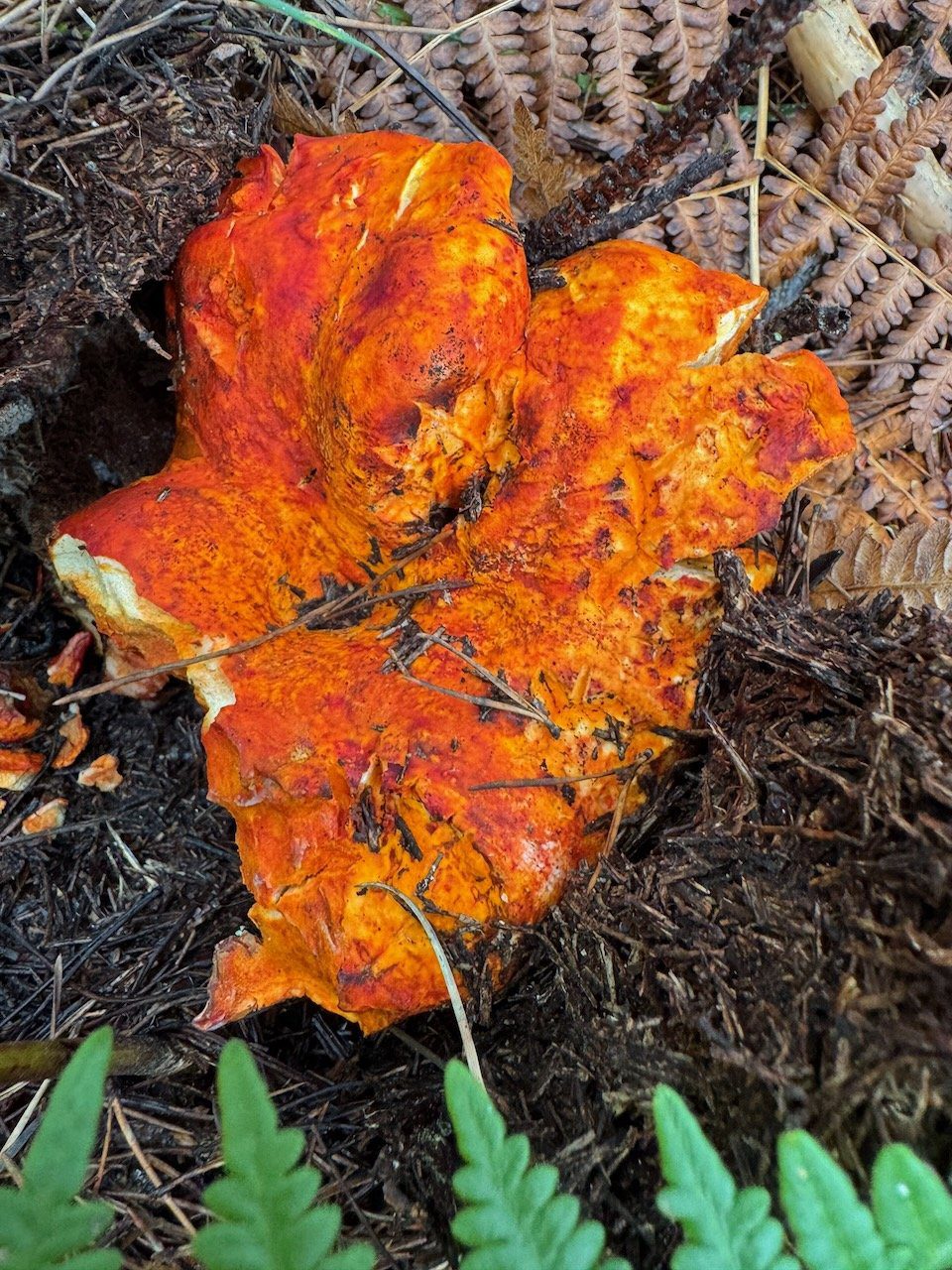
    A bright orange lobster mushroom pushing up through pine needles and fern on the forest floor
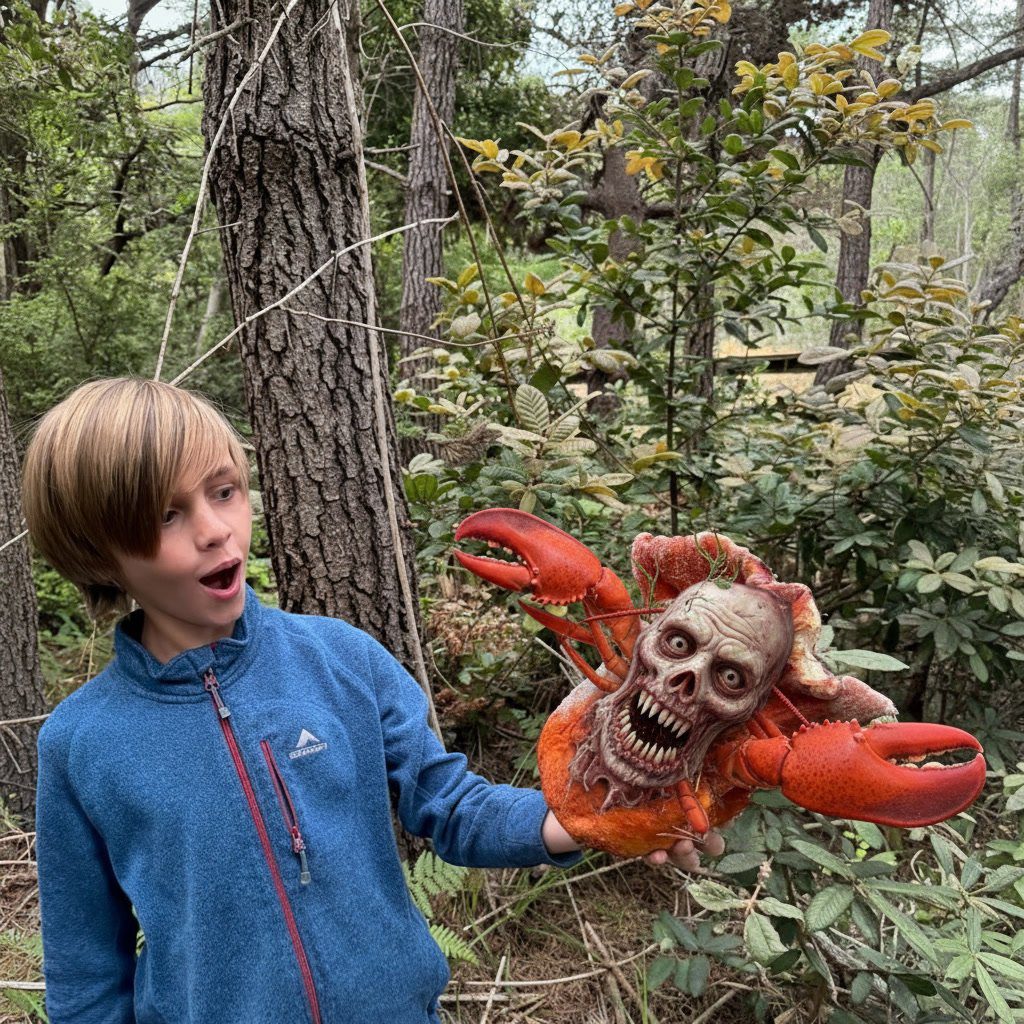
    this is what they actually look like, which isn’t a great deal more reassuring than the picture at the top.

    Walk a coastal forest a week or two after the first real rains and sooner or later something orange stops you dead. It’s the color of a boiled lobster shell, bright enough to catch your eye from ten feet off, and it’s usually only half out of the ground, shouldering the needles and the moss up around itself. Brush the duff back and what comes up hardly looks like a mushroom at all, because it’s a hard orange crust with no gills you’d recognize and a shape that went wrong somewhere early on. It looks like something that washed up rather than something that grew.

    Everything about it says don’t eat me. The color reads as a warning label, the shape reads as a practical joke, and the texture sits somewhere between a cauliflower and a road cone. Hand one to somebody who’s never seen one before and you’ll get a face out of them, every time. Then you take it home, cut it into pieces and fry it in butter with a bit of salt, and it turns out to be one of the best things these woods produce all year.

    What you’re holding is two organisms wearing one body. A lobster mushroom is an ordinary mushroom that’s been hijacked, hollowed out and repainted by something else, and the something else is the part you eat. Zombie is a literal description.

    The thing in charge

    The orange is a fungus called Hypomyces lactifluorum, and it doesn’t make mushrooms at all. It belongs to the Hypocreaceae, which is a family mostly made up of molds, so this is a mold with ambitions. Its spores land on a mushroom, the threads work in, and from then on the two of them grow together with the orange fungus in charge.

    Lewis David von Schweinitz described it in 1822 from material collected in North Carolina and filed it under Sphaeria, and the Tulasne brothers moved it into Hypomyces in 1860, where it’s stayed ever since as the type species of the genus. The name comes from the Latin for milk flowing, after the milk caps it turns up on.

    So “lobster mushroom” is a cook’s name for a partnership, and not a very equal one: the orange crust is the parasite, and the firm white flesh under it started out as somebody else.

    The mushroom underneath

    On this coast the host is almost always a russula, and usually Russula brevipes, the short-stemmed russula, which is a big squat chalk white mushroom with crowded gills and a stem too short for its cap, and it comes up in coastal forest soil in late fall, sometimes in real abundance. Hypomyces lactifluorum takes milk caps too, Lactarius and Lactifluus, including Lactarius deceptivus and the peppery Lactifluus piperatus group, and it works right through North America from Canada down into Mexico. The one under our orange out here is very likely Russula brevipes as well, though nobody’s cut one and proved it, and that’s the trouble with lobsters: the parasite hides whatever it took.

    Russula brevipes, left alone, is nothing much. Field guides call it edible and mediocre, it’s bland, it can carry a peppery bite, and nobody drives anywhere for it. Take that same mushroom, let a mold eat it from the outside in, and it comes out as one of the best wild mushrooms on this coast, and one people pay real money for. The russula gets nothing whatsoever out of the arrangement.
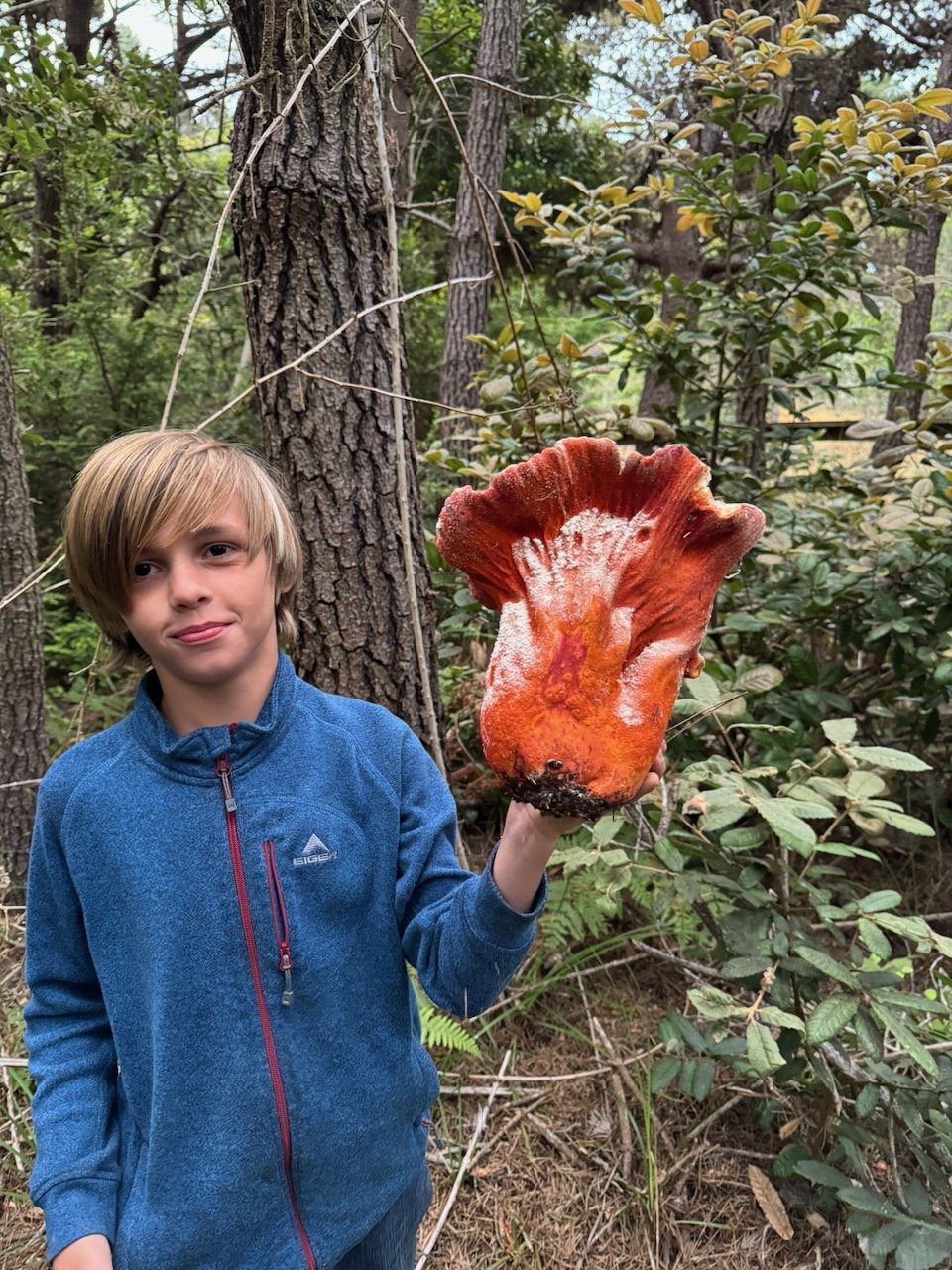
    A boy in the forest holding up an enormous orange lobster mushroom the size of his head
    they get big. This is the same mushroom as the one at the top of the page, before the computer got involved.

    How the takeover works

    Nobody’s entirely settled when the infection starts. One line of work has the spores landing on the gills of a very young host, and another has the two of them meeting underground, mycelium to mycelium, before anything’s come up at all. What isn’t in doubt is how early it happens, because the shape tells you. An infected host never gets to finish. The cap stays lumpy and closed in, the stem comes out short and thick, and the gills never open into gills, which leaves the whole thing looking like a mushroom that got interrupted partway through getting dressed. They stop at blunt ridges and folds, and on an older one they’ve gone under the crust altogether.

    Run a thumb over the surface and it feels pimpled, almost like sandpaper with grit too large for it. Those bumps are the parasite’s own fruiting bodies, called perithecia, and each one is a tiny flask sunk into the crust with its neck at the surface. When they ripen they fire spores out of those necks, spindle shaped and warted and pinched in the middle into two cells. So the host is sterilized as well as deformed, which means the only spores leaving that mushroom now belong to the thing that ate it.

    Which makes the lobster the zombie of the mushroom world. The body’s still there, still standing up in the duff, still shaped roughly like the mushroom it set out to be, and it’s walking around the forest running errands for the thing that took it over. It doesn’t shuffle or moan, in fairness, but the rest of it checks out. What comes out the far end is a transformed freak, and no two of them are the same shape. A good number are barely recognizable as ever having been a mushroom, so part of the fun of finding one is that you’ve no idea what you’re about to pull out of the ground.
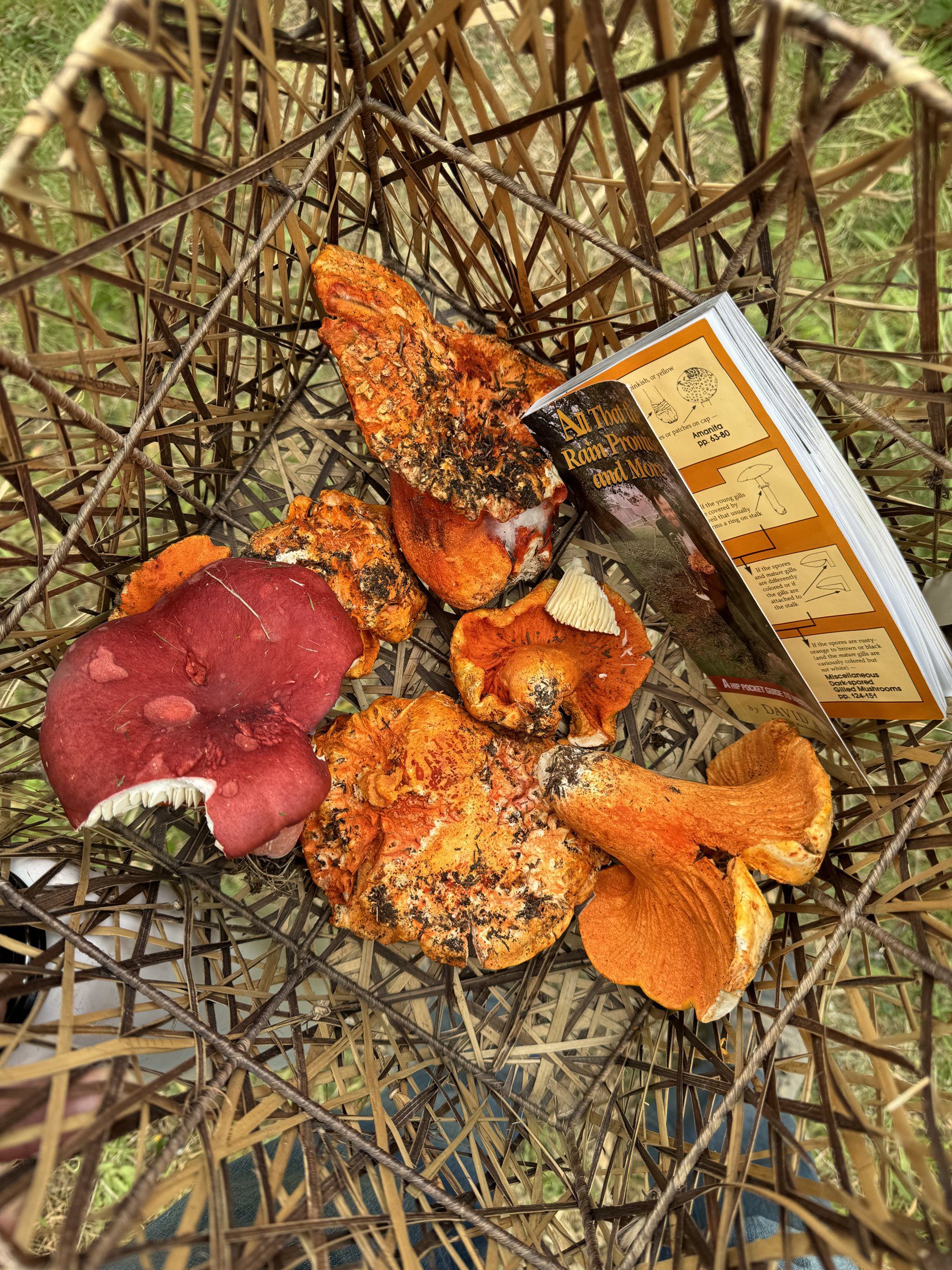
    A basket holding four lobster mushrooms, each a completely different shape, beside a pocket field guide and a red-capped russula
    four of them from one afternoon, and no two the same shape. The red one at the left is a red hot russula, which is a cousin of the lobster’s host and isn’t edible.

    There’s a bit of chemistry that goes with all this too, for anyone who ever puts one under a lens. A drop of potassium hydroxide on the orange crust turns it dark purple almost instantly, and it’ll still do it on a specimen that’s been sitting in a herbarium for decades. Young crust is yellow orange to orange, and with age it blotches magenta and purple on its own.

    What the parasite does to the flavor

    This got properly investigated only recently. A team at the University of Quebec at Trois-Rivieres took lobster mushrooms apart, looked for whose DNA was in there, and found that the flesh is overwhelmingly parasite, with only traces of Russula brevipes left. So the mushroom you’re carrying home is mostly the mold, wearing the russula’s shape.

    Then they looked at the chemistry, and the parasite had rewritten it. The terpenes that a healthy Russula brevipes makes, which are the defensive compounds that carry its bitterness and its bite, were simply gone from the infected ones. Their reading is that the bitter compounds get converted into other, better tasting ones on the way through, which makes the lobster a different food altogether, built out of a russula by something that had no interest in feeding you at all.

    The texture goes the same way. Where a russula is brittle and crumbly, a lobster is dense and firm, and it holds together in a hot pan in a way that very few wild mushrooms manage.
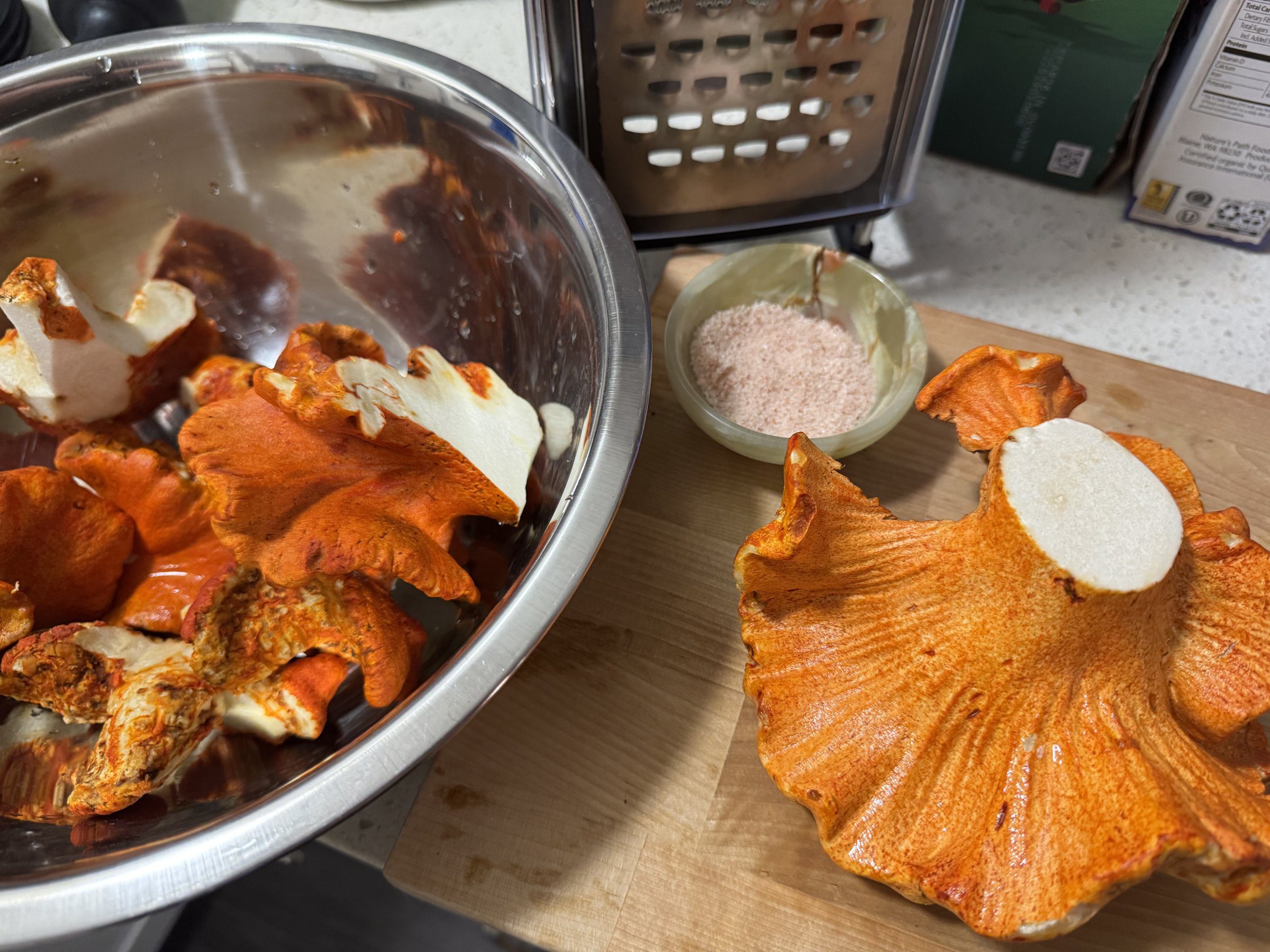
    A large lobster mushroom cut open on a wooden board, bright orange crust outside and solid white flesh inside, with a bowl of cleaned pieces beside it
    orange crust, white flesh, and no gills anywhere. Cut one open and the whole story’s sitting right there on the board.

    Knowing one when you see it

    Lobsters are the easy end of mushroom identification, and it’s the weirdness that makes them easy. The color’s unmistakable, the pimpled crust is unmistakable, and nothing else in these woods is this orange and this ugly at the same time, so what you’re checking for isn’t which species it is, but whether this one’s worth eating.

    A good one is bright orange, firm all the way through when you cut it, and white inside. The smell’s faint and mushroomy, or faintly of shellfish, which is where the name gets its second life.

    Leave the ones that have gone over. Purple and blotchy through the crust, soft anywhere, or a strong fishy smell all mean the same thing, which is that this one’s been sitting in the ground too long and the bugs have found it before you did. Lobsters are tough and they linger, so a patch will happily hold a week’s worth of specimens ranging from perfect to compost. Cut them rather than pulling them, and cut them in half on the spot, because whatever’s going on inside will be obvious and you won’t carry home anything you have to throw away.
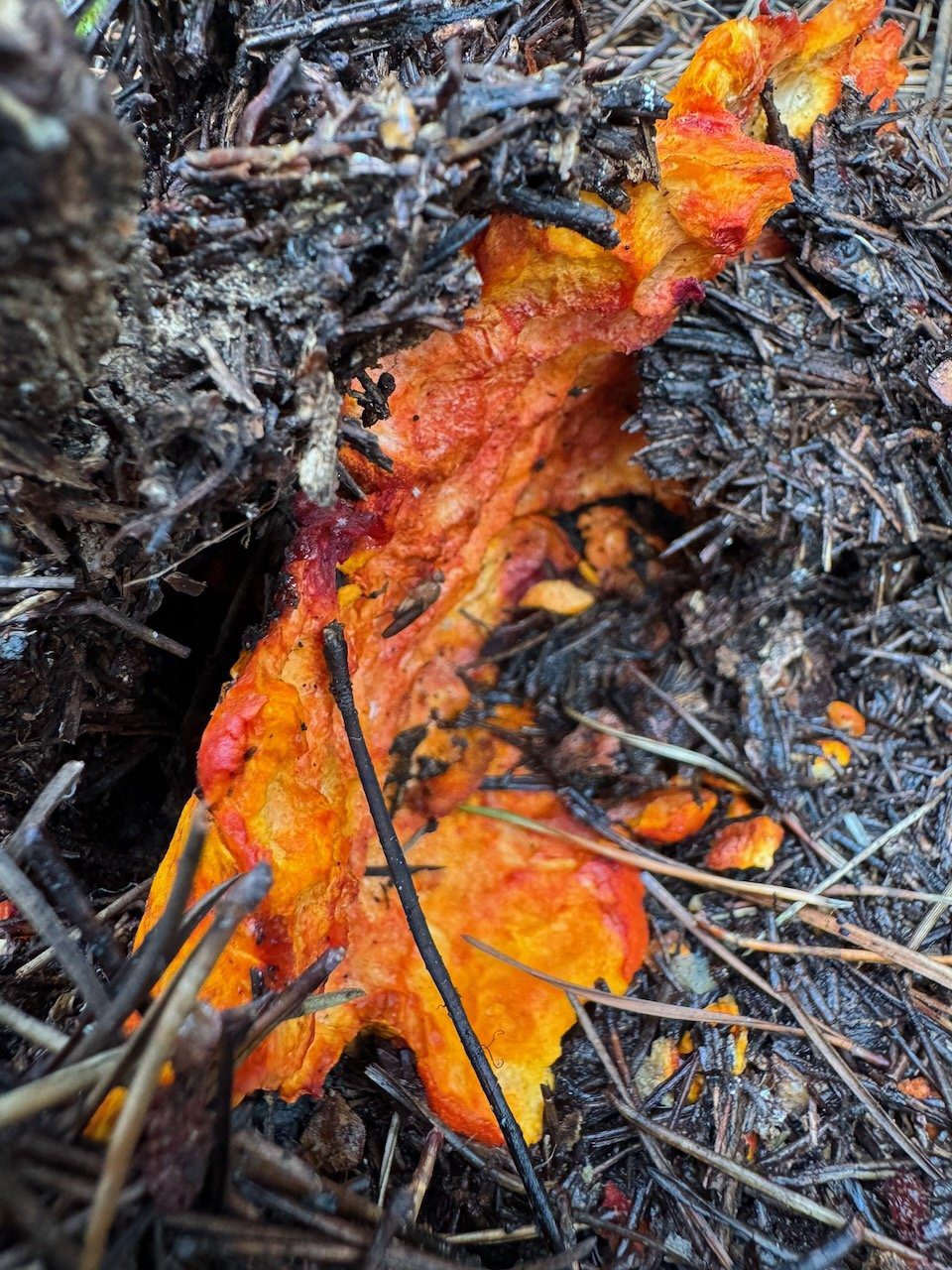
    A lobster mushroom broken into scattered orange fragments on the forest floor, eaten by insects
    too late for this one. Something else got to it first.

    They have to be cooked, like nearly every wild mushroom worth eating. And while lobsters have been eaten across North America for as long as anybody’s been writing it down, a small number of people do get an upset stomach from them, so the sensible rule with any wild mushroom you haven’t eaten before applies: a small portion, well cooked, on its own.

    The question everybody asks

    If the lobster’s a parasite wearing a host, and the host is hidden under the crust, what happens if the host was something poisonous?

    The field guides raise it themselves. In principle the parasite could take a toxic mushroom and you wouldn’t be able to see what it had taken, so the hypothetical is real. But in practice it goes for a narrow set of hosts, the russulas and the milk caps, none of the usual ones is dangerous, and there’s no record of anybody being poisoned this way in the couple of centuries people have been eating them. Nobody’s proved it can’t happen, and most experienced foragers on this coast are content with the two centuries.

    There’s a red hot russula in the basket photo further up. Russula is a big genus and it holds plenty you wouldn’t want on your plate, and that one grows here and isn’t edible. It just isn’t one of the mushrooms the lobster goes after.

    When they come up on the Mendocino Coast

    Lobsters run a long season at camp, because they start showing up in August and they keep coming until around February, which is half the year. The literature has them arriving shortly after the fall rains in north coastal California, with the host at its most common in late fall, so a run that opens in high summer and is still going in late winter is a generous stretch of ground to work with. They’re out in force while the candy caps are still weeks away, and they’re still going when the candy caps finish.

    Rain runs the whole show. A study in eastern Canada that followed lobsters through three seasons found production tracking precipitation closely, with dry years thin, and it found them favoring the edges: trail sides, small gaps in the canopy, and the places where light reaches the ground. That matches how they turn up here, because you’ll find them along the edge of a path more often than deep in the closed forest, so a slow walk with your eyes down is a real search technique, and a lovely way to spend an hour.

    Lobsters are commercially picked in the Pacific Northwest and in Quebec, they show up in grocery stores in Oregon, and they’re sold in markets in Mexico, where they’ve been eaten and named locally for generations. This coast is simply a very good place to run into one.

    Cooking them

    Don’t treat a lobster the way you’d treat a candy cap. The candy cap is a flavoring, used dried and in small amounts, like vanilla. The lobster is a vegetable: you cook it in pieces and you eat it.

    The firm flesh is the whole gift, because it takes high heat without collapsing, it browns properly, and it comes out with a mild, slightly shellfish note that’s launched a thousand chowders. Butter, a hot pan, salt, and not much else is a fine first go. After that it’s good in cream, good with fish, good in a risotto, and very good in anything where you’d otherwise want crab, because the color and the flavor both lean that way and the texture doesn’t fall apart on you. The color holds through cooking too, so a pan of lobster mushrooms is the best looking thing you’ll cook all week.

    Cut the pieces bigger than you think, because a generous chunk of lobster keeps its bite in a way that a thin slice won’t.

    At Camp Candy Cap

    We’ve got lobsters on the property, and they’re common enough that one of the campsites is named for them. Lobster is its own round meadow beside Candy Cap Meadow, it’s the most private spot at camp, and the mushrooms that gave it its name come up nearby.
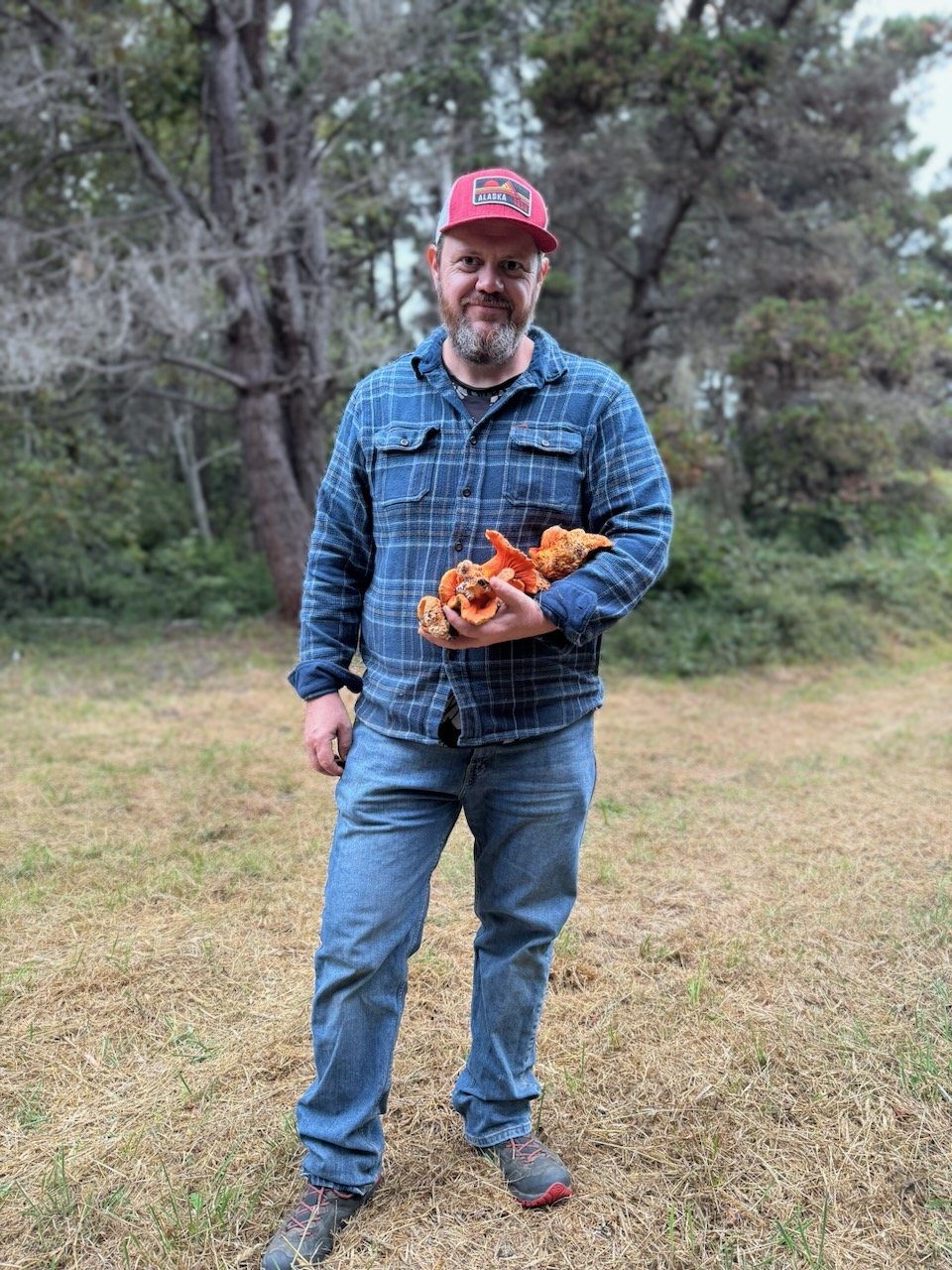
    Richard Gregory standing in a mown meadow holding an armful of bright orange lobster mushrooms
    me, in the meadow, with an armful of them.

    They’re not hard to find here once you know the orange. Every campsite is named for a mushroom that grows at it, and the forest floor goes to work the moment the rains come: candy cap, lobster, reishi, hedgehog, black elfin saddle, porcini, yellowfoot chanterelle, and a long tail of things that need a better mycologist than me to name. Twelve acres of coastal pine and tanoak, wet and mossy and quiet from November on, makes a very good classroom.

    A word about picking. The twelve acres are for learning to see, and we don’t forage them, because a camp that gets picked over in August has nothing to show anybody in February. So the lobsters here stay where they come up, and you get to crouch down in the duff with one, turn the needles back and look at the strangest thing on the property with your own eyes. If you want to fill a basket then the coast is the place, and that’s a different day out with its own rules and its own license.

    Come and find one

    Local folks who know this coast teach here through the season, and the mushroom days run while the ground’s producing. Spend half a day out with somebody who knows where to look and you’ll come back able to find them yourself, and you can stay the night at camp on either side of it and make a weekend of it.

    Nobody expects you to show up knowing anything.

    Camp Candy Cap sits on twelve acres of coastal forest in Fort Bragg, California. You can see the guided days we run over on the Experiences page.


    Camp Candy Cap is a Wilderfolk property on the Mendocino Coast, with camping through the year and guided days out with local folks who know this coast.

    Please note: this article is informational and isn’t a guide to identification. Learn from a qualified expert and a regional field guide, and never eat a wild mushroom you haven’t positively identified.

  • Candy Caps: The Mushroom That Smells Like Maple Syrup

    Candy Caps: The Mushroom That Smells Like Maple Syrup

    A mushroom that smells like maple syrup. Sounds impossible, until you hold one in your hand.

    Please Note: This is an informational article and not intended for identification. Use a qualified identification book and an expert resource when identifying edible mushrooms.

    Every winter, when the rains arrive on the Mendocino Coast, something remarkable happens in the coastal forests. While most tourists stay home and most outdoor businesses shutter for the season, the forest floor comes alive with one of the most unusual edible mushrooms on Earth: the candy cap.

    This small, unassuming mushroom (burnt orange, fragile-stemmed, easy to overlook) carries a secret that has captivated foragers, chefs, and scientists for decades. When dried, it releases an aroma so powerfully reminiscent of maple syrup that it has been used to flavor ice cream, cookies, crème brûlée, and caramel sauce. It is, as far as anyone knows, the only wild mushroom in the world that belongs in dessert.

    Camp Candy Cap, our nature education center in Fort Bragg, is named for this extraordinary fungus. And if you’ve never heard of it before, you’re about to understand why people drive hours through winter storms to find it.

    What Exactly Is a Candy Cap?

    The candy cap most commonly found on the Mendocino Coast is Lactarius rubidus, a member of the milkcap family. Like all Lactarius species, it bleeds a thin, milky latex when its flesh is cut or broken: in the candy cap’s case, a pale, watery fluid that resembles skim milk.

    Fresh candy caps don’t look like much. They’re small, typically less than five centimeters across the cap, with a cinnamon to burnt-orange color that darkens toward the center. The cap starts convex and flattens with age, often developing a slight central dimple and wavy margins. The stem is slender and fragile. Snap it and it breaks cleanly, like chalk. This brittleness is actually a useful identification feature shared by all members of the Lactarius and Russula families, caused by specialized round cells called sphaerocysts in their tissue.

    But the real magic of the candy cap isn’t visible. It’s molecular.

    The Chemistry of Maple Syrup in a Mushroom

    For 27 years, chemical ecologist William Wood of Humboldt State University tried to identify the compound responsible for the candy cap’s extraordinary aroma. The mystery was finally solved in 2012 when Wood and his team isolated the culprit: a compound called quabalactone III, an aromatic lactone present in the fresh tissue and latex of Lactarius rubidus.

    Here’s where it gets interesting. Quabalactone III itself isn’t especially fragrant. But when the mushroom dries, the compound undergoes hydrolysis (a chemical reaction with water) and transforms into sotolon. And sotolon is one of the most powerful aroma molecules known to food science.

    Sotolon is the primary flavor compound in fenugreek seed. It’s present in molasses, aged rum, roast tobacco, and flor sherry. At lower concentrations, it smells unmistakably like maple syrup and caramel. At higher concentrations, it shifts toward curry and fenugreek. It is, in fact, the key ingredient in most artificial maple syrup flavoring.

    This is the same molecule that was responsible for the infamous “mystery maple syrup smell” that periodically wafted across Manhattan starting in 2005. (The source turned out to be a fenugreek processing plant across the river in New Jersey.)

    In the candy cap mushroom, the sotolon is so potent that dried specimens have been documented retaining their aroma for over 60 years in herbarium storage. Handle dried candy caps and your hands will smell like maple syrup for the rest of the day. Heat them in cream and your entire kitchen, your entire house, will fill with the scent.

    The detection threshold for sotolon is astonishingly low: 0.010 nanograms per liter of air. That’s why a few grams of dried candy cap can flavor an entire batch of ice cream.

    The Candy Cap Mushroom, shown here on the right, with a lookalike on the left.
    The Candy Cap Mushroom, shown here on the right, with a lookalike on the left.

    Where and When to Find Them

    Candy caps fruit along the West Coast of North America, from Washington through Oregon and into California. But their heartland is Northern California’s coastal forests, and the Mendocino Coast sits right in the sweet spot.

    Lactarius rubidus is mycorrhizal, meaning it forms a mutualistic partnership with the roots of living trees. The fungus wraps around the tree’s root tips in a structure called an ectomycorrhiza, helping the tree absorb water and nutrients from the soil while receiving sugars from the tree’s photosynthesis in return. On the Mendocino Coast, candy caps associate primarily with conifers (Douglas fir, pine, and spruce), though they also appear under tanoak and live oak.

    Unusually for a mycorrhizal species, Lactarius rubidus is also commonly found growing directly on decaying conifer wood. This dual habitat, both soil and rotting wood, makes the candy cap somewhat easier to find than many other mycorrhizal mushrooms, though “easy” is relative. They’re small, they blend in with the forest duff, and they require hours of stooping and careful looking.

    The season runs roughly from late November through March on the Mendocino Coast, triggered by the arrival of sustained winter rains. November, December, and January tend to be the peak months. This timing is important: candy cap season coincides almost exactly with the period when coastal tourism traditionally drops to its lowest levels. While summer visitors pack the beaches and headland trails, the winter forest offers a completely different, and arguably richer, experience for those willing to get a little wet.

    Why You Shouldn’t Forage Alone (At Least Not at First)

    Here’s the part where we need to be direct: candy caps are small, brownish-orange mushrooms that grow in the same habitat as dozens of other small, brownish-orange mushrooms. Some of those lookalikes are merely unpleasant. Others are dangerous. One (Galerina marginata, the deadly galerina) is lethal.

    The good news is that candy caps have a combination of features that, taken together, make positive identification quite reliable for someone with proper training. But each individual feature on its own is insufficient.

    Key identification features of Lactarius rubidus:

    The mushroom must bleed pale, watery, milk-like latex when the flesh is cut. This latex should not change color when exposed to air. (Beware Lactarius xanthogalactus, a common lookalike in Northern California whose latex turns yellow quickly; this species is considered poisonous.) The stem should snap cleanly, like chalk, rather than bending or tearing fibrous. The cap surface should feel slightly bumpy or nubbly when you run a finger across it, not smooth, not slimy. A useful field trick: briefly singe the flesh with a match or lighter. Candy caps will release a sweet, maple-like aroma under heat even when fresh specimens lack a noticeable smell. The taste of the flesh and latex should be mild to slightly sweet, with absolutely no bitterness or acridity. (Note that some toxic lookalikes have a subtle bitterness that may take a minute to develop, so chew a tiny piece and wait.)

    Finally, the spore print should be white to pale yellow. Galerina marginata, the deadly lookalike, produces a rusty brown spore print, one of the most important distinguishing features.

    This is why we believe so strongly in guided foraging education. A few hours with an experienced instructor teaches you to see the forest differently, to read the trees, the soil, the moisture, the elevation, and to develop the kind of pattern recognition that keeps you safe and makes you successful. Our mushroom foraging programs pair you with local experts who have been walking these forests for years.

    Cooking with Candy Caps: The Dessert Mushroom

    Candy caps are not eaten the way you’d eat a chanterelle or a porcini. They’re used more like a spice. Think vanilla, saffron, or truffle. And because the aroma intensifies dramatically with drying, they’re almost always used in dried form.

    There are three primary methods for getting candy cap flavor into food:

    Infusing in dairy. This is the method most pastry chefs prefer. Crumble dried candy caps into warm cream or milk, let them steep until the liquid is deeply fragrant, then strain. The fat in the dairy dissolves the flavor compounds beautifully. The infused cream can then be used as the base for ice cream, panna cotta, custard, ganache, or any cream-based dessert. This is probably the most forgiving technique for beginners. It’s hard to over-extract, and the results are immediately impressive.

    Grinding to powder. Dried candy caps can be ground in a coffee grinder or spice mill to produce a fine powder that can be added directly to cookie dough, cake batter, pie filling, or spice rubs. A little goes a very long way: two to four grams can flavor an entire batch of ice cream. Fair warning: your grinder will smell like maple syrup for weeks afterward, which most people consider a feature rather than a bug.

    Making candy cap sugar. Layer dried candy caps with granulated sugar in a sealed jar, shake daily, and wait a week or two. The mushrooms will perfume the sugar with their aroma. Strain out the mushrooms and use the sugar anywhere you’d normally use plain sugar: in shortbread, crème brûlée, caramel sauce, or stirred into coffee. The flavor pairs especially well with brown butter, toasted nuts, chocolate, and bourbon.

    Classic candy cap preparations include ice cream (the single most popular use), cookies, bread pudding, panna cotta, and caramel sauce. But adventurous cooks have also used them in savory applications, anywhere maple syrup would traditionally appear. Think candy cap-glazed pork, candy cap vinaigrette, or candy cap-infused bourbon.

    Commercially, dried candy caps can sell for upwards of $200 per pound, making them one of the most valuable wild mushrooms in North America. But a little goes so far that even a small amount foraged on a guided walk provides enough for multiple desserts.

    The Ecology Beneath Your Feet

    When you learn about candy caps, you’re really learning about the invisible infrastructure that holds a forest together.

    The mycorrhizal network that candy caps participate in is sometimes called the “wood wide web”, a vast underground system of fungal filaments connecting tree roots across the forest floor. Through this network, trees share nutrients, send chemical warning signals about pest attacks, and support struggling neighbors. The fruiting body you see on the surface, the mushroom, is just the reproductive structure. The real organism is a sprawling network of threadlike hyphae woven through the soil and into the roots of multiple trees.

    When you find a patch of candy caps, you’re looking at a visible sign of this hidden partnership. The mushroom is, in a very real sense, the fruit of a relationship between fungus and forest that may be decades old. Understanding this changes the way you move through the woods. You stop seeing trees as isolated individuals and start seeing the forest as a connected, communicating community.

    This is what we teach at Camp Candy Cap: not just identification, but ecology. Not just “what can I eat” but “how does this forest work, and what’s my role in it?”

    A Winter Reason to Visit the Coast

    The Mendocino Coast in winter is a different world from the summer version. The light is different, soft and silvered. The ocean is dramatic, with storm swells and whale spouts visible from the headlands. The forests are impossibly green, saturated with rain, draped in moss and fern and lichen. And the air smells like wet earth and wood and the faint sweetness of decay that signals the mycelium doing its work underground.

    For most of the outdoor tourism industry, winter is the off-season. For mushroom foraging, it’s prime time. The Mendocino Coast hosts over 3,000 species of fungi, of which roughly 500 are edible. Chanterelles, hedgehogs, porcini, black trumpets, and of course candy caps all fruit in the wet months. November through February is when the coast’s forests are at their most productive and most magical.

    This is the season that inspired the name Camp Candy Cap, and the season we think offers the most rewarding experiences for visitors willing to trade beach weather for rain gear and a basket.

    Learn to Forage the Right Way

    Camp Candy Cap offers guided mushroom foraging programs throughout the wet season, led by local experts who know these forests intimately. You’ll learn not just identification but ecology: the relationships between fungi and trees, the role of moisture and microclimate, the ethics of sustainable harvesting, and how to read the landscape to find productive ground.

    The mushroom tour is a half day out with somebody who knows where to look, and it runs through the wet season while the ground is producing. You can stay the night at camp on either side of it and make a weekend of it.

    Nobody expects you to show up knowing anything.

    Camp Candy Cap sits on twelve acres of coastal forest in Fort Bragg, California.

    You can see the guided days we run over on the Experiences page.


    Camp Candy Cap is a Wilderfolk property on the Mendocino Coast, with camping through the year and guided days out with local folks who know this coast.

  • The Lost Art of Tent Camping

    The Lost Art of Tent Camping

    There’s something undeniably sacred about the act of pitching a tent under the open sky, surrounded by the scent of pine, the crackle of a fire, and the hum of crickets. Tent camping strips the experience down to its essential core: the rhythm of nature, the simplicity of shelter, and the raw beauty of the outdoors. It reconnects you with something ancient and instinctive. You’re not just visiting nature, you’re living in it, exposed to its sounds, its moods, and its whims. Morning sunlight filters through the nylon, and the dew on your boots becomes part of the ritual. There’s no thermostat, no flush toilet, no curated amenities, and that’s the point.

    Compare that with RV camping, where convenience is king. A cozy bed, a built-in kitchen, sometimes even satellite TV. It’s a rolling home, and for many people, it lowers the barrier to outdoor experiences. RVs make camping more accessible to families with small kids or folks with mobility challenges, and that’s valuable. But there’s a trade-off: by recreating comfort, RVs often create a buffer between us and the wild. They insulate us from the very unpredictability that makes nature so thrilling. And in doing so, some of the magic gets lost. With every added luxury, a little more of the primal experience slips away. The stars look a bit dimmer from a lighted camper window, and the night air smells a little less wild when filtered through an AC vent.

    Tent camping, on the other hand, doesn’t let you off the hook so easily. You feel the chill of the night, the dampness of the morning, the wind testing your shelter. And you rise to it. There’s something inherently satisfying about being forced to pay attention to your environment. You scan the horizon for a level site. You tie knots. You strike a match with purpose. It’s not hardship. It’s engagement.

    The Cost of Gentrified Camping

    Over the years, camping has evolved, and not always for the better. What used to be a rugged rite of passage is increasingly becoming a curated, Instagrammable weekend getaway. Campgrounds now offer Wi-Fi, food trucks, yoga classes, and “glamping” tents with real beds, electricity, and even air-conditioning. Yes, it’s more comfortable. But it’s also more detached. The traditional skills of building a fire, setting up camp, or navigating by map are fading. And along with them, the quiet pride that comes with roughing it.

    More troubling still, many campgrounds are shifting their infrastructure to accommodate RVs and larger vehicles. Spacious, shady tent sites are being converted into gravel pads with hookups. Campfires are being replaced with propane grills. Even national parks are feeling the pressure to modernize. The result? The very wildness that makes these places special is slowly being chipped away.

    Primitive camping (just you, your gear, and the woods) isn’t always easy. But it’s real. It invites humility, adaptability, and presence. It’s about getting dirty, troubleshooting in the dark, and letting your senses sharpen. There’s immense value in discomfort, in inconvenience. It reminds us of our own resilience. It teaches problem-solving, patience, and creativity. Most of all, it strips away the noise of daily life and leaves you with nothing but your surroundings and your thoughts.

    So before you book that plush RV site with the cable hookup and firepit Wi-Fi, consider unrolling a sleeping bag under the stars instead. You might rediscover a part of yourself you didn’t know you’d lost.

    The Mental Health Case for Primitive Spaces

    There’s a growing body of research that supports what many campers have known instinctively for generations: time in nature heals. And more specifically, immersive, primitive nature experiences, those that lack modern convenience, are uniquely powerful in their mental health benefits.

    A 2019 study published in Frontiers in Psychology found that as little as 20 minutes in nature can significantly lower cortisol levels, the body’s primary stress hormone. But more immersive experiences (those without phones, screens, or artificial light) are where the deeper benefits take root. When you’re in a tent, without reception, and the closest thing to a screen is the flicker of a fire, your brain shifts. The noise settles. Attention spans lengthen. Sleep improves. And perhaps most importantly, you begin to feel more present.

    Primitive camping removes the digital scaffolding we’ve come to lean on. No more dopamine hits from notifications. No checking email before your feet hit the forest floor. That kind of mental decoupling is rare, and increasingly vital. The modern world is full of overstimulation. Primitive camping offers a mental palate cleanse. A full reset. Even a weekend away, without electricity or a phone signal, can boost your mood, clarity, and sense of calm for days afterward.

    Moreover, the mental rewards don’t just come from the stillness. They come from the challenge. Psychologists often talk about “eustress,” a kind of positive, productive stress that builds confidence and capability. Primitive camping introduces eustress in a healthy, manageable way: lighting a fire without lighter fluid, cooking with limited tools, finding your way by map and intuition. These tasks build self-trust. They remind us that we’re capable of far more than our ultra-convenient lives typically demand.

    In a culture that often equates well-being with comfort, it’s easy to forget that discomfort is where growth happens. Tent camping doesn’t just offer a break from the world. It offers an opportunity to reconnect with yourself.

    Why It’s Worth Reclaiming the Wild

    Let’s be honest: primitive camping isn’t for everyone, at least not all the time. There’s value in having options, in making nature more accessible. But we risk losing something precious when we default to convenience. The wild, in its truest form, doesn’t need to be polished or softened. It doesn’t need to cater to our routines. In fact, its greatest power comes from the way it disrupts them.

    When you crawl into a tent after a long day of hiking, you’re not just resting, you’re returning. To something primal. To something honest. To a rhythm that’s been humming along long before we invented plumbing and power strips. That’s the joy of tent camping. It doesn’t pretend to be anything other than what it is: raw, real, and wildly restorative.

    So bring your sleeping bag. Pack light. Leave the Bluetooth speaker at home. The less you bring, the more space you make: for silence, for clarity, for awe. Because in the quiet corners of a forest or along a starlit bluff, tent zipped shut, you’ll find something RVs can’t offer: the deep, unfiltered magic of being small in a big, beautiful world.

  • Reading the Mendocino Coast Through the Seasons

    Reading the Mendocino Coast Through the Seasons

    Most of California gets busy in summer and quiet in winter. This coast does the opposite. Our richest season is the wet one, when the rains bring the mushrooms up and the whales move past offshore and most of the visitors have gone home. If you only ever come in August you will have seen the least interesting version of the place.

    What follows is the year as we actually experience it, month by month, from twelve acres of coastal forest outside Fort Bragg. It is a guide to when, not a guide to what is safe to eat. Learn identification from someone who knows the ground before you put anything in your mouth, and follow the state fishing and gathering rules, which are real and which change.

    Winter

    November, the season begins

    The first sustained rains wake the forest floor. Within a week or two the candy caps start coming up under the pines, small and burnt orange, smelling of maple syrup once they dry. Golden chanterelles and the first hedgehogs appear alongside them, and porcini may still be flushing from the fall. Gray whales begin moving south. The first negative low tides of the season fall in the afternoon.

    December, the heart of it

    Candy caps, chanterelles, hedgehogs, black trumpets and yellowfoot can all be up in the same week after a good rain. This is the month the camp is named for. Cold, wet, quiet, and the forest doing its best work. Southbound whales peak around now and can be watched from the headlands without a boat.

    January, deep winter

    Mushrooms continue for as long as the rain does. The forest turns a green that is difficult to describe to anyone who has not stood in it: moss, fern and lichen on every surface. Storm swells make for dramatic days on the bluffs, and the winter minus tides open the pools again.

    Spring

    February, the shift

    Mushroom season winds down as the botanical year wakes up. Seaweed becomes the story on the big spring low tides, gathered by the rules and at the right hour. The first wildflowers show on the bluffs. Gray whales start heading back north.

    March, tide pools and whales

    Peak whale watching as the grays move north, some of them with calves. The lowest daytime tides of the year open the pools wide: ochre sea stars, anemones, sea palms, urchins. Seaweed is at its best.

    April, wildflowers and low water

    The bluffs come into bloom and the tide pools stay generous on the spring lows. The light gets long. A good month to learn the pools and the shoreline plants before the summer crowds arrive.

    Summer

    May, the coast opens up

    Long days and the fog settling into its summer rhythm, in by night and out by noon. Tide pools still good on the morning lows. The first hints of the berry season.

    June, long light

    Full summer. Salmonberries and thimbleberries ripen at the forest edges. Wildflowers hold on the bluffs. Good dry weather for fire building and the rest of the hands-on work.

    July, berries and fire

    Blackberries start along the sunny edges. Dry enough for real fire craft. Tide pools on the early morning lows. Peak visitor season, and the coast at its most generous.

    August, high summer

    Blackberries at their peak and huckleberries beginning to ripen in the understory. Warm, dry and long. The last full month before the light starts to change.

    Fall

    September, the turn

    Huckleberries ripe and heavy under the trees, which is the best eating month for them. The light goes softer and lower. If the rains come early, the first thinking about mushrooms starts here.

    October, waiting for rain

    The whole forest is waiting. When the first real rain arrives, the fall porcini flush and the earliest chanterelles can appear, and matsutake is possible in the right stands. Huckleberries finishing.

    November again

    The rains return and the cycle starts over, and the coast heads into its richest and quietest season while everywhere else packs up. This is our favorite time to have people out.

    How to read this coast, wherever you are

    Follow the rain, not the calendar. Mushrooms come a week or two after the first sustained rains, whenever that lands. A dry November pushes the whole season back.

    Follow the tide charts. The best tide pooling and seaweed days are the negative low tides. In winter they fall in the afternoon, in spring around midday.

    Take only what you will use, and learn the rules. Marine Protected Areas, bag limits and seasons are real, and they change. Check before you gather. When in doubt, leave it where it is.

    Learn from someone who knows the ground. A few hours with a good instructor is worth a season of guessing, and it keeps you safe.

    The point of any of this is not the harvest. It is learning to read the place.

    Come and learn it in person

    We teach all of this at Camp Candy Cap: mushroom identification in the wet season, tide pools and seaweed in spring, fire and coastal skills in summer. Classes are open to the public, kept small on purpose, and members of the Wilderfolk Camping Club choose dates first and pay less.

    If you would rather read along from wherever you are, we made a printable month-by-month version of this calendar. You can get it here, and we will send a note when each season turns.